
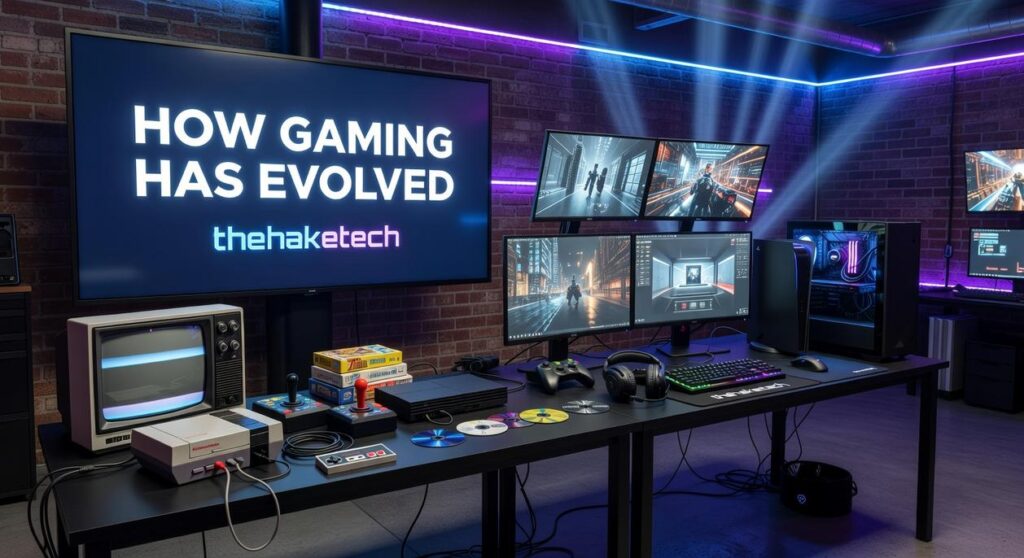
I’ve been gaming since pixels were just colored blocks on a screen.
You’re probably here because you want to understand how we went from Pong to games that look like real life. But most gaming history reads like a boring timeline of consoles and release dates.
That’s not what this is.
I’m going to show you how gaming has evolved thehaketech by connecting the actual innovations that changed how we play. Not just what got released, but what mattered when you had the controller in your hands.
Each tech leap didn’t just make games look better. It changed the rules. It opened up new strategies and made things possible that weren’t even imaginable before.
I’ve spent years breaking down game design and studying what makes mechanics work. I focus on the why behind the changes, not just the what.
This article walks you through gaming’s biggest technological moments in order. You’ll see how arcade cabinets evolved into home consoles, how 3D graphics changed everything, and how we ended up with the hyper-realistic virtual worlds we play today.
No fluff. Just the tech breakthroughs that actually transformed gaming and why they still matter.
The Genesis: Arcade & 8-Bit Era (1970s-1980s)
Let me take you back to where it all started.
The 1970s and 80s gave us something special. Games built on MOS 6502 CPUs with RAM you could measure in kilobytes (not gigabytes). ROM cartridges that clicked into place. CRT displays that hummed in the background.
Here’s what matters about this era.
Developers had almost nothing to work with. So they got creative in ways we still see today.
Think about Pac-Man. You chase dots, avoid ghosts, grab power pellets, and repeat. That’s it. But that loop kept people pumping quarters into machines for hours. Same with Donkey Kong. Jump over barrels, climb ladders, save the girl.
The limitations forced brilliance.
When you only have a few kilobytes of memory, every byte counts. You can’t hide bad design behind flashy graphics or complex systems. The gameplay has to work.
And that’s where controller feel was born.
Those simple D-pads and buttons? They created something we take for granted now. A direct line between your thumb and what happens on screen. No input lag. No complicated button combinations. Just press right and Mario moves right.
(Try explaining that to someone who grew up with modern controllers and they’ll look at you like you’re ancient.)
Now, some people say these old games are too simple. That we’ve moved past needing to understand how gaming has evolved Thehaketech from these basics. They argue modern games are just better in every way.
But here’s my take.
If you want to understand why games feel the way they do today, you need to know this era. The concept of lives? That came from arcade cabinets needing your quarters. Continues? Same reason. These weren’t just design choices. They were business models baked into gameplay.
My recommendation? Play at least one game from this period.
Pick up Pac-Man or Donkey Kong. Spend 20 minutes with it. Feel how tight the controls are. Notice how quickly you understand the rules. See how the difficulty ramps up through pattern recognition, not tutorials or cutscenes.
You’ll start seeing these same principles in every game you play after that.
The Great Leap Forward: 16-Bit Consoles & The Dawn of 3D (Early-Mid 1990s)
Let me explain what actually happened when consoles jumped to 16-bit.
Everyone talks about better graphics. But that’s not the whole story.
The real shift? Processors got smart enough to handle multiple layers of movement at once.
The Motorola 68000 CPU (the brain inside the Sega Genesis) could process way more information per second than the old 8-bit chips. That meant developers could finally create what’s called parallax scrolling.
What’s parallax scrolling?
It’s when background layers move at different speeds to create depth. Think of it like looking out a car window. Trees close to you zip by fast while mountains in the distance barely move.
Games like Sonic the Hedgehog used this to make 2D worlds feel alive. You weren’t just running left to right anymore. You felt like you were moving through actual space.
But here’s where things got wild.
Sony’s PlayStation introduced a dedicated GPU (graphics processing unit) that could render 3D polygons in real time. Nintendo had tested this with the Super FX chip in games like Star Fox, but PlayStation made it standard.
Polygons are just geometric shapes. Triangles mostly. String enough of them together and you get a 3D character or environment.
This changed everything about how gaming has evolved thehaketech and game design. Developers weren’t limited to flat planes anymore. They could build worlds with height and depth. You could walk around objects instead of just jumping over them.
The analog stick showed up around this time too. Makes sense when you think about it. Moving in 3D space with a D-pad feels clunky.
And then there’s CD-ROM technology.
Cartridges maxed out at maybe 64 megabytes. CDs could hold over 600 megabytes. That’s ten times more space for bigger worlds, voice acting, and full-motion video cutscenes.
Some of those FMV sequences were cheesy (I’m looking at you, early Resident Evil). But they made games feel like interactive movies.
The Connected World: Online Multiplayer & Persistent Worlds (Late 1990s-2000s)

I remember the first time I heard my modem screech to life.
That sound meant something was about to change.
Some people say this era ruined gaming. They argue that online multiplayer killed the magic of sitting next to your friends on the couch. That it turned games into toxic cesspools where strangers scream at each other over headsets.
And look, I get where they’re coming from. News Gaming Industry Thehaketech picks up right where this leaves off.
But here’s what actually happened.
The late 90s and early 2000s didn’t destroy gaming. They expanded it in ways we couldn’t have imagined. When the Dreamcast rolled out with built-in internet capability, followed by PS2 and Xbox, we weren’t just getting a new game console thehaketech. We were getting access to something bigger.
Dial-up gave way to broadband. Suddenly, dedicated servers could handle dozens of players at once. Netcode improved enough that you could actually hit what you were aiming at (most of the time).
Games like Quake and Halo proved that human opponents were way more interesting than AI. You couldn’t predict what another person would do. Every match felt different.
Then MMOs came along and changed everything again.
EverQuest and World of Warcraft created something we’d never seen before. Persistent worlds that kept going whether you were logged in or not. Your guild might be raiding while you were at work. The economy shifted based on what thousands of players were doing.
This is where how gaming has evolved thehaketech really shows itself. Server-side computing meant the game world was alive. It breathed. It changed.
You weren’t just playing a game anymore. You were part of a living digital space with its own social rules and communities.
Yeah, we lost some of that couch co-op intimacy. But we gained something else. A global hobby where you could team up with someone in Tokyo at 2 AM or join a clan that became your second family.
The technology wasn’t perfect. Lag was real. Dial-up disconnects happened at the worst times (usually mid-raid). But the foundation was set.
Gaming stopped being something you did alone in your room. It became social in a way that would define the next two decades.
The Modern Era: HD, Physics, and Procedural Generation (Mid 2000s-Present)
When the Xbox 360 and PS3 launched, I remember thinking graphics couldn’t get much better.
I was wrong.
But here’s what most people miss when they talk about this era. It wasn’t just about prettier visuals.
Some argue that all these technical advances made games worse. They say physics engines and procedural generation led to bloated, unfocused experiences. That developers prioritized tech demos over good game design.
And honestly? Sometimes they’re right. I’ve played plenty of games that looked stunning but felt empty.
But that’s not the whole story. I expand on this with real examples in Thehaketech Gaming Hacks From Thehake.
What Really Changed
Multi-core processors and GPUs running shader models 3.0 and beyond gave developers tools they’d never had before. Havok and PhysX engines meant objects could interact in ways that felt real.
You could stack boxes to reach a ledge the developers never intended. Or blow a hole through a wall instead of finding the key.
That’s what how gaming has evolved thehaketech has shown us. The best new games thehaketech covers today use these systems to create genuine player choice.
Take Minecraft. Procedural generation created worlds that felt endless (even though they technically weren’t). No two players had the same experience.
Or look at No Man’s Sky. At launch it disappointed millions. But the underlying tech was sound. The procedural systems could generate 18 quintillion planets.
The problem wasn’t the technology. It was what they did with it.
The Distribution Revolution
Here’s what nobody talks about enough.
Steam, Xbox Live, and PSN didn’t just change where you bought games. They changed what games could be.
Before digital distribution, shipping a broken game meant you were stuck with it. Now developers could patch and update constantly.
This led to games as a service. Some people hate this model. They want complete experiences at launch, not years of updates and DLC.
I get that frustration.
But it also meant games could grow and improve. Developers could respond to player feedback in real time. Communities could shape the games they loved.
Pro tip: Check a game’s update history before buying. It tells you whether the developers actually support their work or just cash out and disappear.
Where Reality Meets Play
Ray tracing changed lighting in ways most players don’t consciously notice. But your brain knows the difference.
Reflections look right. Shadows fall where they should. Light bounces off surfaces naturally.
Combined with 4K displays and HDR, the gap between game and reality got razor thin. Not because everything looks photorealistic (plenty of stylized games exist). But because the underlying systems behave like the real world.
Environmental destructibility added another layer. Shooting through drywall. Blowing up cover. Creating new sightlines.
These weren’t just visual tricks. They changed how you approached problems.
The best part? Advanced AI meant NPCs could actually respond to your creative solutions. They’d adapt, flank, and react like thinking opponents instead of following scripts.
This era gave us the tools to play games our own way. Not everyone used them well. But when they did? Magic happened.
The Unwritten Code of the Future
We’ve moved from simple pixels to worlds that feel alive.
Each step forward gave developers new tools to build experiences that pull you in deeper. Better tech meant more than prettier visuals. It meant games could finally do what creators always imagined.
How gaming has evolved thehaketech shows us something clear: the real revolution wasn’t about graphics alone. It was about creating moments that stick with you.
Think about the games that changed everything for you. The ones where you felt something real.
Those experiences happened because someone had the right tools at the right time.
Now we’re standing at another edge. Cloud gaming is removing barriers. AI-driven NPCs are starting to feel less scripted and more human. VR and AR are blending worlds in ways we’re just beginning to explore.
The next chapter is being written right now.
Here’s what I want you to think about: Which technological leap hit you the hardest? Was it the jump to 3D worlds? Online multiplayer that connected you with players across the globe? The moment you first put on a VR headset?
Look back at your favorite titles. The tools shaped what those games could become.
And the tools we have now are going to shape what comes next.
 Kelvor Thryndell is the kind of writer who genuinely cannot publish something without checking it twice. Maybe three times. They came to gamer gear optimization hacks through years of hands-on work rather than theory, which means the things they writes about — Gamer Gear Optimization Hacks, Tech-Powered Game Strategy Guides, Pro Perspectives, among other areas — are things they has actually tested, questioned, and revised opinions on more than once.
That shows in the work. Kelvor's pieces tend to go a level deeper than most. Not in a way that becomes unreadable, but in a way that makes you realize you'd been missing something important. They has a habit of finding the detail that everybody else glosses over and making it the center of the story — which sounds simple, but takes a rare combination of curiosity and patience to pull off consistently. The writing never feels rushed. It feels like someone who sat with the subject long enough to actually understand it.
Outside of specific topics, what Kelvor cares about most is whether the reader walks away with something useful. Not impressed. Not entertained. Useful. That's a harder bar to clear than it sounds, and they clears it more often than not — which is why readers tend to remember Kelvor's articles long after they've forgotten the headline.
Kelvor Thryndell is the kind of writer who genuinely cannot publish something without checking it twice. Maybe three times. They came to gamer gear optimization hacks through years of hands-on work rather than theory, which means the things they writes about — Gamer Gear Optimization Hacks, Tech-Powered Game Strategy Guides, Pro Perspectives, among other areas — are things they has actually tested, questioned, and revised opinions on more than once.
That shows in the work. Kelvor's pieces tend to go a level deeper than most. Not in a way that becomes unreadable, but in a way that makes you realize you'd been missing something important. They has a habit of finding the detail that everybody else glosses over and making it the center of the story — which sounds simple, but takes a rare combination of curiosity and patience to pull off consistently. The writing never feels rushed. It feels like someone who sat with the subject long enough to actually understand it.
Outside of specific topics, what Kelvor cares about most is whether the reader walks away with something useful. Not impressed. Not entertained. Useful. That's a harder bar to clear than it sounds, and they clears it more often than not — which is why readers tend to remember Kelvor's articles long after they've forgotten the headline.